What is a stadium bowl?
A stadium bowl refers to the bowl-shaped spectator area where seats are arranged in curved, concentric rows around a field, stage, or arena.
This design optimizes sightlines, acoustics, and the overall experience for spectators, making it possible to host large crowds without losing connection to the event. Stadium bowls combine architecture, engineering, and event logistics to balance safety, atmosphere, and capacity.
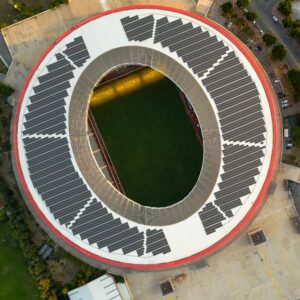
Stadium Bowl
Design and features
A typical stadium bowl consists of one or more continuous tiers of seating rising from the field or stage, often separated by concourses.
The shape can be circular, oval, or adapted to the location’s characteristics. The angle of the seats, row spacing, and elements like railings and emergency exits are all carefully planned to support comfort and crowd flow.
Amenities such as kiosks, toilets, circulation paths, and VIP areas are integrated to enhance the stadium experience.
Read more interesting descriptions in our dictionary here
Historical and modern significance
The bowl design traces its roots to ancient amphitheaters, where crowds sat on sloped terraces around an event. It remains a key principle in both modern stadium construction and renovation.
Today, the stadium bowl often features as a city landmark and serves as a gathering place for sports, concerts, and major cultural events.
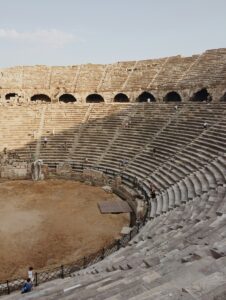
ancient amphitheaters
Concrete examples of stadium bowls
Some of the most famous stadiums in the world employ a bowl-shaped design:
- Rungrado 1st of May Stadium (Pyongyang): The world’s largest stadium, with a capacity over 114,000 and a massive bowl-shaped structure encircling the entire field.
- Brøndby Stadium: With around 29,000 seats, this Danish stadium features a continuous bowl for enhanced closeness and acoustics.
- Wembley Stadium (London): One of the world’s most recognized, famous for its enormous bowl and capacity of up to 90,000.
- Camp Nou (Barcelona): Europe’s largest football stadium, whose stands form several distinct bowl tiers for excellent sightlines.
- Allianz Arena (Munich): Noted for its spectacular bowl, with the illuminated facade linking function and atmosphere.
- Signal Iduna Park (Dortmund): Famous for its “Yellow Wall” and bowl-shaped stands, creating an intense atmosphere and optimal viewing.

Camp Nou (Barcelona)
The stadium bowl is a central feature in traditional and modern stadium architectures. It forms the basis for crowd experience, atmosphere, and the city’s collective moments. The design philosophy has evolved over centuries, but the main principles remain: optimal sightlines, event proximity, safety, and striking architecture.
Are you interested in more concrete statistics? See the Stats & Records category here:
Do you need clearer explanations of venue‑related concepts? See the Stadiums & Arenas category here:
Do you need explanations of equipment and gear? See the Equipment & Gear category here:


